


Within the PISTIS Project, Virtual Vehicle Research (VIF) contributes as leader of the “automotive demonstrator hub”, showing how trusted data sharing can directly improve road safety. Our focus is on transforming cross-domain data into actionable driver warnings in near real time.
VIF has developed a driver warning app together with a service backend that consumes data from the PISTIS platform. The backend generates driver-relevant events such as crashes ahead or dangerous curves by combining map data, in-vehicle data and weather information.
The system integrates two main data sources via PISTIS:
- Streaming (simulated) vehicle data from
- CARUSO Weather data from UBIMET
CARUSO provides near real-time vehicle signals, including speed, crash indications and other driving-related parameters.
UBIMET contributes high-quality weather data, enabling the system to assess environmental conditions such as heavy rain, low visibility or icy roads.
The VIF backend continuously processes these data streams and identifies potentially hazardous situations as events.
Based on this analysis, the system generates structured warning events that are requested by the driver application via a geo-spatial key (GSK), which is periodically sent to the backend.
The app retrieves relevant events and evaluates them within a defined driving corridor. For certain event types, such as dangerous curves, the app also considers current speed and weather conditions before deciding whether a warning should be issued.
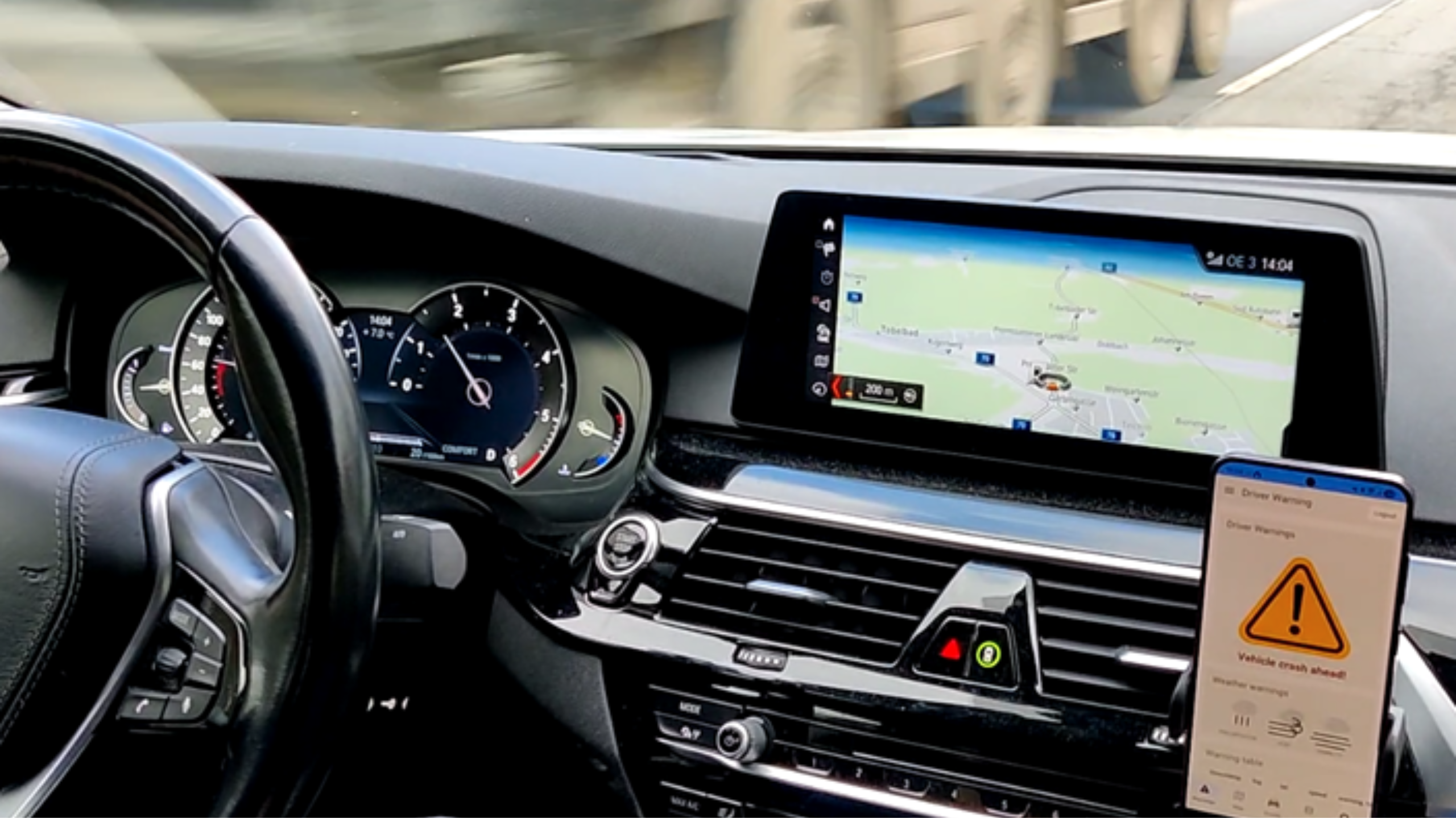
A practical example shown in the image is a “vehicle crash ahead” warning. In this case, streaming in-vehicle data from CARUSO is transmitted to the PISTIS platform, including information about a crash event. For demonstration purposes and to adhere to GDPR guidelines, virtual vehicles and synthetic data are used to avoid any real incident. The VIF driver warning system consumes this data from the PISTIS platform, detects a crash situation within the driving corridor and generates a warning that is displayed to the driver. This allows following drivers to react early and adapt their driving behaviour.


